
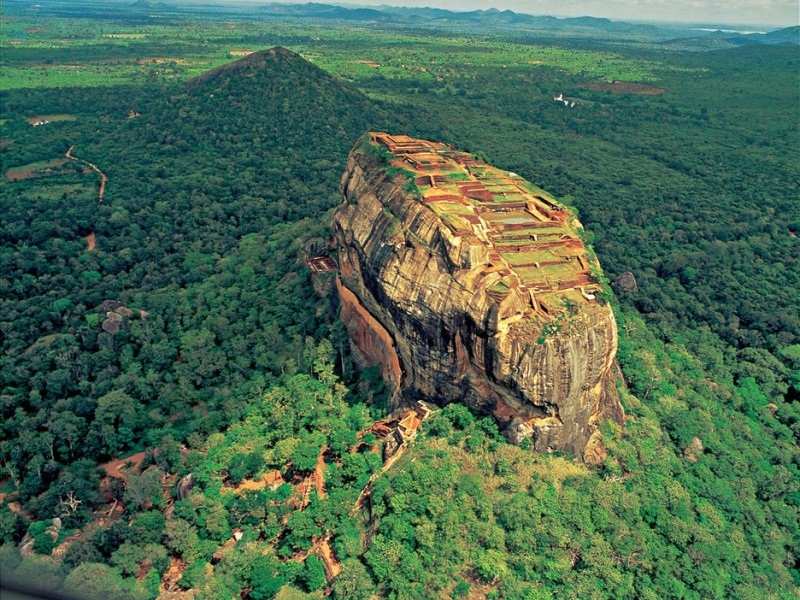
Everybody who travel to Sri Lanka make sure to climb Sigiriya rock and take a picture at the oddly shaped entrance that looks like two feet of a lion. I was pretty curious the first time I saw this and wanted to learn more about this rock fortress.
So during my trip to Sri Lanka, I befriended a local girl whose father coincidentally turned out to be a Professor in History. It was as if I had hit jackpot, as the father generously told me quite a bunch of anecdotes and helped me in devising my itinerary.
I managed to clarify all the things I wanted to about the rock fortress.
- What is Sigiriya?
Sigiriya has gotten it’s name from the structure of its architecture. The entrance to the castle is supposed to have looked like a Lion’s Mouth back in the day. In Sinhala “Sigiriya” is translated as “lion’s mouth”. Today only the front paws of the lion remains. However, the isolated rock has been where King Kassapa, of the Anuradhapura took refuge after he killed his father, the king Datusena whom he thought to have favored his brother. As an attempt to flee from his outraged brother, Mugalan he fled atop the 200m tall rock outcrop and made a fortress with few of the world’s best-known architectural forms.
- Architecture
The king did not simply stop at camping on a rock and sleeping under the stars, instead his talented architects built a fully functioning palace atop the rock, and surrounded the area with a breathtaking water garden, with sprinklers, moats with crocodiles in them, that kept out intruders. From atop Sigiriya, the Garden looks well-kept and quite picturesque. The technique used by the ancient Sri Lankan engineers to carry the water up to the top of the Rock, still remains a mystery to the rest of the world.
- The Frescoes
Dating back to the 5th century, the Frescoes of Sigiriya were first discovered by the archaeologist H.C.P. Bell. The artists of the time are said to have made colors out of barks of trees and flowers. The paintings are of semi-naked women, Golden and Blue. Some say that they represent the wives of King Kassapa, while others say they are paintings of goddesses visiting the nearby Pidurangala rock. The visitors to the palace in the later centuries are said to have been overcome with desire after seeing the paintings and scribbled poetry on the mirror wall.
- The Mirror wall
The mirror wall at Sigiriya is said to have been as reflective as a mirror once, However with time, it has dulled in its lustre. Over later centuries merchants and noblemen have left graffiti on the mirror wall as tribute to the palace, and the painting of beautiful women. The graffiti varies from laments, awe, and simple statements declaring that they were once visitors of Sigiriya. After King Kassapa’s death the castle had been converted into a Monastery, after being abandoned for centuries and letting vegetation overtake the premises.
Today, Sigiriya is one of the most spectacular places to visit within the island. It is further declared as a UNESCO World Heritage Site.